
From free data to rising tariffs, India’s telecom story is no longer about disruption—it’s about a fight for dominance and staying relevant.
The telecom sector has transformed from a crowded battlefield to what is called a duopoly, a market dominated by Reliance Jio and Bharti Airtel, with smaller players like Vodafone Idea (Vi) and BSNL scrambling to survive. But what does this concentrated market mean for the average Indian subscriber? This analysis cuts through the noise to evaluate the real consumer impact of this duopolistic era.
India’s telecom journey has been dramatic. A decade ago, more than a dozen operators competed fiercely, driving data costs down to historic lows. Today, that landscape has shrunk to a two-faced portrait. According to the Press Information Bureau, the Telecom market share is given as follows:

Dominance, Decline, and Concentration
The two player market structure was the result of a long, grinding process where brutal competition collided with unforgiving economics. In the early 2010s, the market was highly fragmented, with operators competing aggressively on price after the 2G and 3G spectrum auctions. This fragmentation intensified after the 2016 entry of Reliance Jio, which triggered a price war by offering free voice and ultra-cheap data. While consumers benefited in the short term, the industry’s financial health deteriorated rapidly: sector-wide debt crossed ₹7 lakh crore, Average Revenue Per User (ARPU) collapsed below ₹100, and weaker players such as Aircel, Tata Teleservices, and later Idea Cellular either exited or merged. [1]
Regulatory pressures, high spectrum costs, and relentless capex requirements for 4G and 5G made survival impossible without scale. The 5G adoption curve further deepens the duopoly. Reliance Jio and Bharti Airtel were able to launch 5G long before Vodafone-Idea, giving them a head start. While Vodaphone-Idea launched 5G services in 2025, BSNL is yet to launch commercial 5G services and only started offering pan-India 4G services in September 2025. [2]
Over time, only two private players: Jio and Bharti Airtel were able to sustain losses, raise capital, invest consistently, and expand networks, while others lost subscribers and struggled with execution.
Pricing Power: From Free Data to Price Hikes
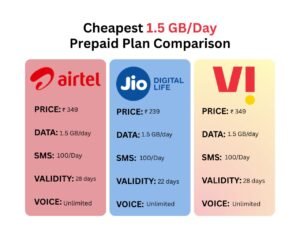
Perhaps the most tangible impact for consumers is in pricing. Duopoly poses fears of companies raising prices at will and taking advantage of their market power. However, India currently offers some of the lowest telecom prices in the world, which explains why many consumers appear indifferent to this ongoing consolidation.
The initial telecom disruption from Jio in 2016 had brought data prices down to as low as ₹10–₹15/GB. But those days are now gone. Operators, now focused on profitability rather than sheer market share, have signaled multiple tariff hikes of 10–12% or more as they shift strategies toward premiumisation and higher Average Revenue Per User (ARPU). [3]
What does this mean numerically? Jio’s ARPU stood near ₹211, while Bharti Airtel’s was higher at roughly ₹256 by late 2025, yet both figures are rising as plans targeting high-data usage and enterprise services proliferate. [4] Such moves may bolster profitability, but they reduce affordability, especially for rural and low-income users who once flocked to cheaper tiers.
Quality and Innovation
While the duopoly may tighten pricing, it has also enabled both leaders to invest heavily in infrastructure where others cannot.
This investment shows up in the following manner to boost quality and customer satisfaction [5]:
- Broader 5G coverage
- 5G Fixed Wireless Access (JioFiber and XStream Fiber)
- Satellite-based communications services
- Hyperscale data centers
- AI-enabled network management
Yet investment isn’t evenly felt. Subscribers in many regions still face patchy speeds, congestion during peak hours, and a lack of compelling differentiation between competitors’ offerings. Critics argue that infrastructure investment doesn’t always translate into proportionate improvements for retail users, especially when prices climb faster than service quality.
Consumer Impact: The Balancing Act
So is this duopoly a net positive or negative for consumers? The answer isn’t so simple:
- Price wars have eased, leading to more sustainable economics for operators but higher costs for users.
- Network investments have accelerated, particularly in 5G, yet service quality gains are uneven.
- Innovation continues, but it is now focused more on higher-paying customers rather than the mass market.
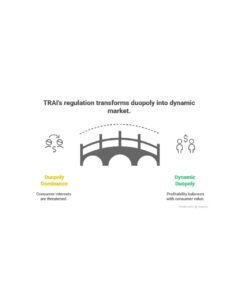
Regulation is the key wildcard. Transparent tariff oversight, quality benchmarks, and safeguarding consumer rights will determine whether this duopoly becomes a dynamic duopoly – one that balances profitability with consumer value. In India, this role rests with the Telecom Regulatory Authority of India (TRAI), supported by the Department of Telecommunications (DoT) and the Competition Commission of India (CCI). Through scrutiny of anti-competitive behavior, regulators can prevent abuse of dominance and ensure that consumer interests affordability, service quality, and fair choice remain protected in the digital era.
Contributor: Team Leveraged Growth


