
Ever walked out of a mall with bags full of items you never planned to buy, or checked your inbox only to find an impulse online purchase you don’t remember rationally deciding on? You’re not alone.
We often assume that our buying decisions are logical: we weigh the need, compare options, and then pick the best deal. But the truth is, much of our spending is driven by psychological triggers that businesses and marketers know how to exploit. Our brains rely on shortcuts, and these shortcuts, while useful, make us vulnerable to overspending.
Let’s uncover three of the most powerful psychological biases that trick our wallets: Anchoring, FOMO, and Instant Gratification.
Anchoring: The Price Trap
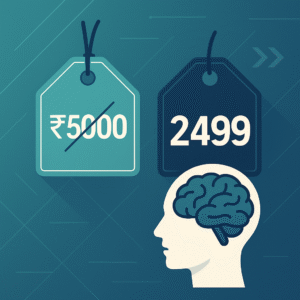
Anchoring occurs when the first piece of information we see sets the standard for all future comparisons. In the context of shopping, it’s often the initial price tag.
Imagine spotting a shirt priced at ₹5,000. You hesitate, but then you notice a bright red tag: “Now ₹2,499 – 50% Off!” Suddenly, the deal looks irresistible. Your brain isn’t evaluating whether the shirt is truly worth ₹2,499; it’s comparing it to the “anchor” of ₹5,000.
Luxury brands use this strategy all the time. Walk into a high-end store, and you’ll notice that the most expensive products are displayed first. Once you see a jacket for ₹50,000, a ₹15,000 pair of shoes seems “reasonable” in comparison, even if you never intended to spend that much.
Anchoring works because our brains crave reference points. Instead of calculating actual value, we compare against the first number we encounter.
FOMO: Fear of Missing Out
If you’ve ever rushed into a purchase because of a flashing “Only 2 left in stock!” message, you’ve been a victim of FOMO.
Fear of Missing Out exploits our natural aversion to loss. Psychologically, the pain of losing out on something is stronger than the pleasure of gaining it. This principle, known as loss aversion, pushes us to act quickly when scarcity or urgency is highlighted.
Think about flash sales during Black Friday or festive shopping festivals. People often end up buying televisions, gadgets, or clothes they never planned for simply because the timer was ticking down and stock was limited.
The irony is, we’re not always buying the product; we’re buying relief from the anxiety of potentially regretting not buying it.
Instant Gratification: The Dopamine Hit
Our brains are wired to prefer immediate rewards over delayed ones, a concept psychologists call present bias. Shopping feeds this bias perfectly.
Each time you click “Buy Now,” your brain releases dopamine – a feel-good chemical associated with reward and pleasure. That’s why online shopping feels exciting, even addictive.
The trouble is, the joy of buying now outweighs the pain of paying later. Credit cards, EMIs, and Buy Now Pay Later (BNPL) schemes make this worse by separating the purchase from the payment. You enjoy the instant rush but postpone the financial reality.
Consider impulse buys – snacks near the checkout counter, a sudden gadget purchase, or an extra subscription you don’t really need. In the moment, they feel rewarded. Weeks later, the regret sets in when the credit card bill arrives.
How to Break the Cycle
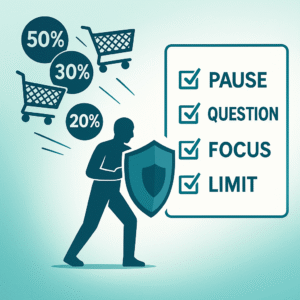
The good news is that by understanding these psychological triggers, you can train yourself to resist them. Here’s how:
- Pause Before Buying – Give yourself a 24-hour cooling-off period for non-essential purchases. Often, the initial excitement fades.
- Question the Anchor – When you see a “discount,” ask: Would I still buy this if I had only seen the final price?
- Challenge Scarcity – Remind yourself that “last chance” deals are often artificial marketing tactics. If you didn’t need it yesterday, you probably don’t need it today.
- Fight Instant Gratification – Compare the momentary pleasure of buying with your long-term financial goals. Saving for travel, education, or investments often feels far more rewarding when you take a step back.
- Limit Triggers – Unsubscribe from promotional emails, mute shopping app notifications, and avoid endless scrolling. Out of sight, out of mind, works surprisingly well.
Final Thoughts
Our brains are powerful, but they aren’t always rational when it comes to money. Anchoring convinces us that discounts are better than they really are. FOMO rushes us into decisions out of fear. Instant gratification makes us prioritize short-term pleasure over long-term well-being.
Marketers have mastered the art of nudging us into overspending. But awareness is your shield. The next time you’re tempted by a deal that feels too good to pass up, pause and ask yourself: Is this something I truly need, or is it just my brain playing tricks on me?
Because at the end of the day, your wallet deserves honesty – even if your brain doesn’t always offer it.
Contributor: Team Leveraged Growth


