
There is a quiet transaction happening every weekend across urban India. At first glance, it looks like a lifestyle trend, with people joining running clubs, pottery workshops, dance classes, cycling groups, trekking communities, and recreational sports leagues. But beneath the surface lies something far more significant: urban Indians are increasingly spending money not just on activities and material things, but on an opportunity for real human connections. And the economics behind that choice reveal a great deal about who we are becoming as a society.
The Loneliness No One Talks About
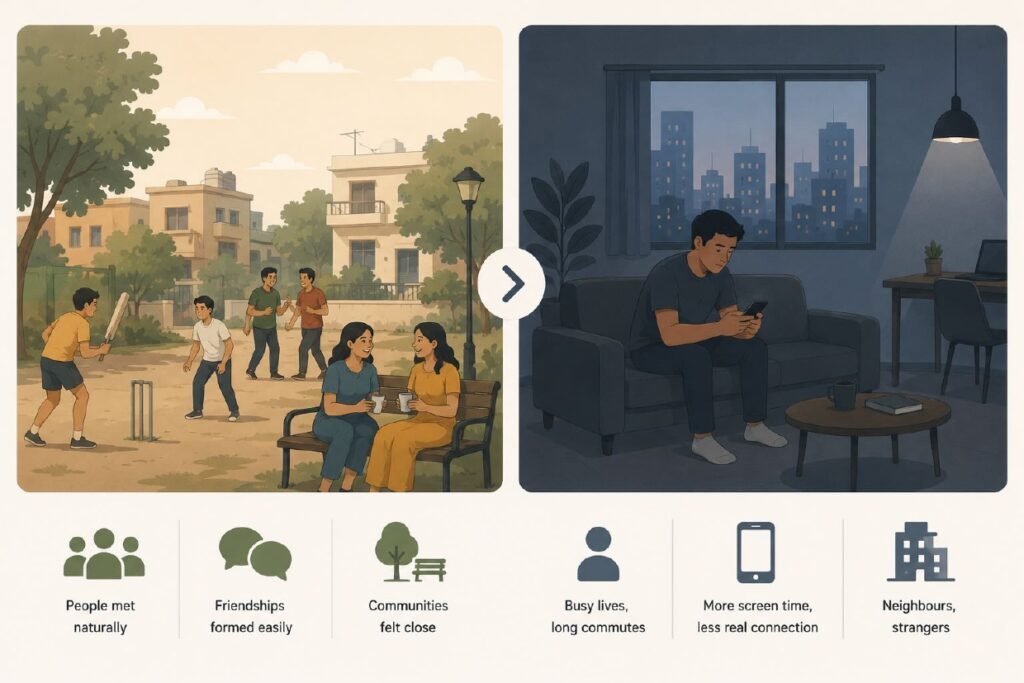
There was a time when social interaction happened naturally. People played cricket in empty plots, met neighbours during evening walks, attended local music classes, or simply spent time outside their homes. Indian cities functioned around community. Families knew other families, neighbourhoods felt familiar, and friendships formed through repeated proximity rather than deliberate effort.
Modern urban India looks very different. Cities have become efficient places to work and consume, but not necessarily easy places to belong. Young professionals migrate away from hometowns into apartments where neighbours barely interact. Long commutes, demanding work schedules, remote work, and frequent relocation make maintaining friendships increasingly difficult.
At the same time, digital life has created the illusion of constant connection while often reducing physical interaction. India may have hundreds of millions of internet users, but urban loneliness has quietly become one of the defining emotional realities of city life.
A few trends highlight this shift clearly:
- Surveys across urban Indian workplaces have shown that more than half of employees openly report feeling lonely, especially among migrants in the 25–35 age group.
- During the pandemic, large numbers of urban Indians reported feeling more isolated despite spending more time online than ever before.
- Many cities today offer countless spaces to consume, but very few spaces designed simply for recurring community interaction.
What many people realize after college is surprisingly simple: modern cities provide very few natural systems through which adults regularly meet new people.
That gap is where modern hobbies enter the picture.
The Collapse of “Accidental” Socializing
Earlier generations built friendships through what urban planners call “third places”, which were social spaces that were neither home nor workplace. Parks, neighbourhood gatherings, local clubs, religious spaces, markets, and community events created recurring interaction naturally.
Indian cities urbanised faster than they built such social infrastructure. What replaced those spaces was often passive consumption: malls, food delivery apps, streaming platforms, and social media. Leisure became increasingly individualised. The result is not dramatic isolation, but a quieter absence of recurring, low-pressure human interaction outside work and family obligations.
Modern hobbies solve this problem elegantly because they remove the awkwardness of engineered socialising. A pottery class, running club, or cycling group gives strangers a structured reason to interact repeatedly without the pressure of formal networking. Over time, familiarity develops naturally.
That consistency matters psychologically. Human connection is built less through intensity and more through repeated presence. Seeing the same people every weekend often creates stronger bonds than occasional parties or endless online conversations.
The Rise of the Experience Economy
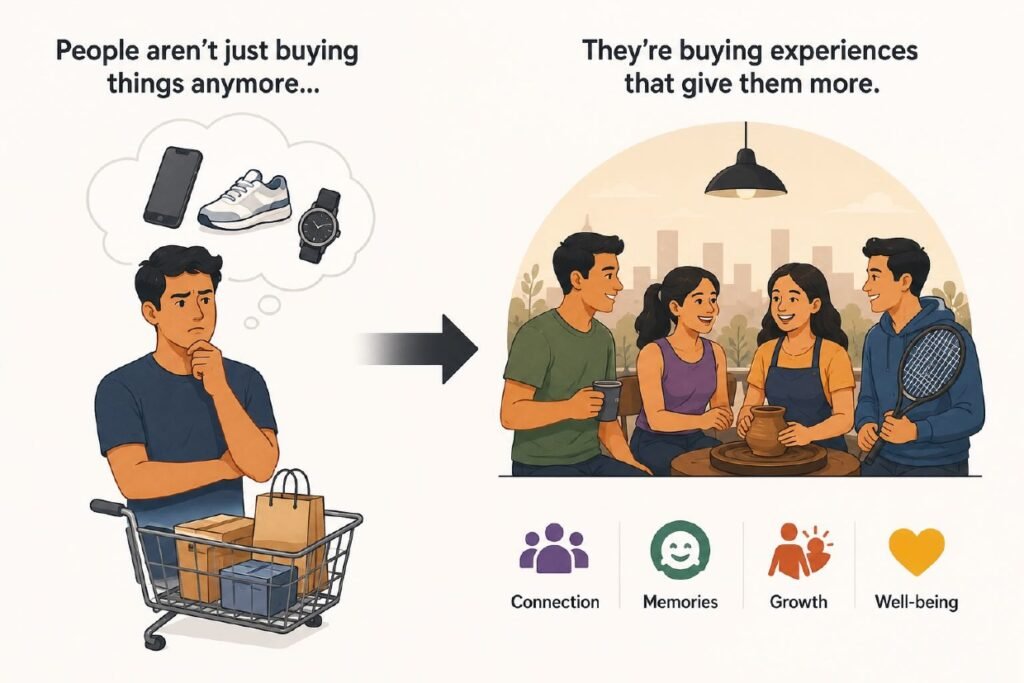
The growth of social hobbies also reflects a larger shift in consumer behaviour. Earlier generations associated success mainly with ownership, homes, cars, jewellery, and durable assets. Younger urban Indians increasingly prioritise experiences instead.
Travel, workshops, fitness memberships, wellness spaces, cafés, and recreational communities now occupy a growing share of discretionary spending. According to Alive’s 2025 Experience Study, spending on experiences among urban Indians grew nearly 90% compared to 2024 levels, with many users spending ₹4,000–₹5,000 on same-day activity bookings discovered online. Around 55% of this spending now goes toward learning-led experiences such as workshops, hobby classes, and interactive activities rather than passive entertainment.
Part of this shift is cultural, but part of it is economic. Experiences provide something possessions increasingly cannot: identity, memory, and social visibility. Lifestyle has become a form of personal branding, and hobbies now communicate discipline, creativity, ambition, health, and social activity.
Social media amplifies this trend further. Marathon medals, trekking photos, pottery sessions, and cycling trips become forms of content as much as leisure. Once an activity becomes associated with a desirable urban lifestyle, businesses rapidly emerge around it through memberships, cafés, tournaments, merchandise, and digital communities.
The Business of Belonging
Markets eventually monetise needs that society no longer fulfils naturally, and modern hobbies are increasingly becoming part of that process.
What appears to be a fitness trend or leisure activity often functions as emotional and social infrastructure. A running club may look like exercise, but it also provides routine, identity, familiarity, and participation. A dance workshop is rarely just about dancing.
Businesses understand this clearly. Many modern consumer brands are now built less around products and more around community retention. Fitness studios host mixers. Hobby platforms create WhatsApp groups and recurring events. Recreational clubs build membership ecosystems because customers emotionally attached to a social environment are far more likely to stay loyal.
The economics are simple: customers paying purely for utility can leave easily. Customers attached to a social ecosystem usually stay.
In many ways, urban businesses today are no longer merely selling recreation or entertainment. Increasingly, they are selling structured belonging.
The Pickleball Case Study
Few examples capture this shift better than pickleball.
A sport that was virtually unknown in India a few years ago has suddenly exploded across major cities through rooftop courts, gated communities, sports clubs, and converted badminton facilities. Courts are opening rapidly across metros and even Tier-2 cities, while startups and investors are building businesses around the sport.
At first glance, its rise appears surprising. Pickleball is neither India’s most competitive sport nor its most culturally established one. But its success makes perfect sense when viewed socially rather than athletically.
The numbers themselves are striking:
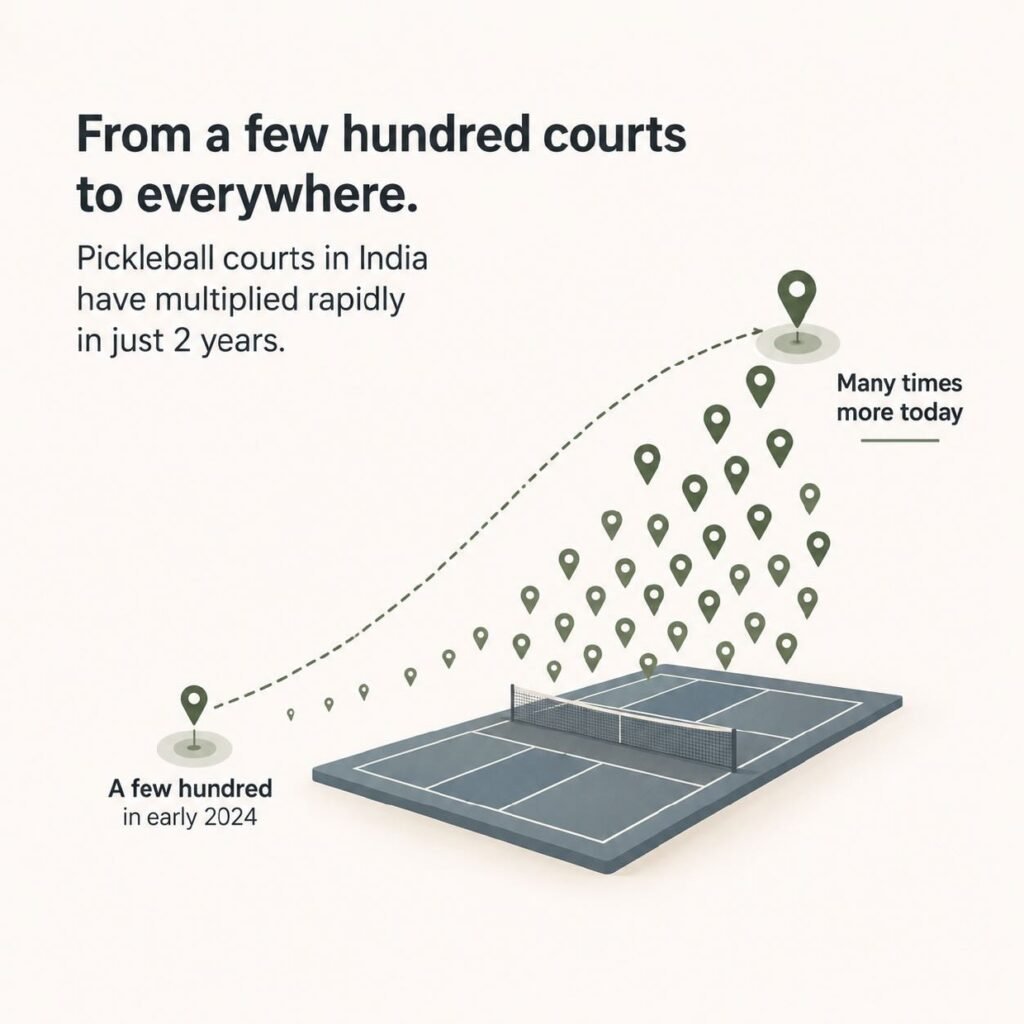
- India had only a few hundred operational pickleball courts in early 2024, and the number has multiplied rapidly within just two years.
- Sports-booking platforms have reported massive growth in pickleball listings and monthly bookings.
- Investors and startups are increasingly treating pickleball not merely as a sport, but as a scalable urban community business.
Pickleball is built almost perfectly for modern urban lifestyles. Unlike tennis, it is easy to learn quickly. Unlike gyms, it encourages conversation. Unlike nightlife, it does not rely heavily on exclusivity or expensive spending. Most importantly, strangers can comfortably participate together within minutes.
The social barrier to entry is extremely low.
That matters enormously in cities where adults struggle to meet new people naturally. The sport creates repeated, low-pressure interaction through short games, rotating partners, casual conversations, and recurring sessions. Over time, the court itself becomes less important than the familiarity surrounding it.
This is why pickleball has evolved into a broader lifestyle ecosystem. Courts are increasingly attached to cafés and social spaces. Weekend tournaments double as networking environments. Influencers document games online, while startups build apparel brands, booking platforms, coaching businesses, and membership communities around the sport.
But beneath all the commercial activity lies a much simpler reality: people are not only paying to play. They are paying for an environment where social interaction feels easy again.
The Final Takeaway
The rise of modern hobbies reveals something important about urban India. Economic growth has created financially independent individuals faster than socially connected communities. As traditional systems of interaction weaken, people increasingly turn toward paid experiences to rebuild routines, friendships, and a sense of belonging.
That is why hobbies today feel fundamentally different from hobbies a generation ago. They are no longer simply ways to pass the time. Increasingly, they are becoming one of the primary ways urban Indians construct social life itself.
The court may be the product. The workshop may be the service. But the real commodity being bought and sold is human connection.
Disclaimer
This blog is for educational and informational purposes only and does not constitute investment or financial advice. Please consult a SEBI-registered financial advisor before making investment decisions.
Contributor: Team Leveraged Growth


