
When you think of Meta, chances are Instagram reels, WhatsApp chats, or Facebook memes pop into your head. But here’s a twist: Meta isn’t really in the business of running social media platforms. Its true business is far simpler, and way more powerful. Meta sells ads, and the fuel for that machine is your time and attention.
In Q2 2025 alone, Meta reported $47.5 billion in revenue, with a staggering $46.6 billion of that coming from advertising. That’s over 97% of total earnings from just showing ads. So how exactly does Meta turn our daily scrolling into this advertising empire? Let’s break it down.
Time = Money
Every minute you spend scrolling, liking, or watching reels is valuable real estate for advertisers. Think of your feed like a highway. The more traffic (users) there is, the more billboards (ads) companies want to place there.
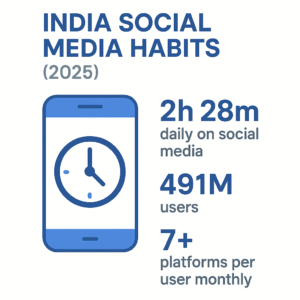
Globally, people spend over 2 hours a day on social media, and in India, the number is even higher, at around 2 hours and 28 minutes daily. With 491 million social media user identities in India alone, Meta controls one of the largest highways in the world.
And here’s the kicker: the longer you stay, the more ads can be shown to you. More ads = more revenue.
Ads: The Cash Machine
Meta’s ad model is insanely profitable for one reason: precision. Unlike old-school TV or newspaper ads where businesses hoped the right audience would see their message, Meta already knows who you are, what you like, what you’ve searched, and even how long you lingered on that sneaker post.
This allows advertisers to target you with almost surgical accuracy. Selling a fitness app? They can push it directly to 20-year-olds in Mumbai who follow diet pages. Promoting sneakers? They’ll target those who recently searched “best running shoes.”
That’s why ads on Instagram often feel spookily relevant – they’re designed that way.
Data Is the New Oil
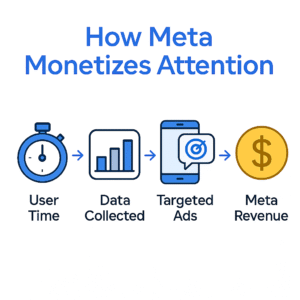
Meta isn’t just passively showing ads, it’s actively collecting data points every time you use its platforms. Every like, follow, pause, and share tells Meta something about you. This information powers sophisticated algorithms that predict what content will keep you engaged and what ads you’re most likely to click.
The more data Meta gathers, the smarter its targeting becomes. Advertisers love this because it increases conversions, and Meta loves it because smarter targeting means they can charge more for each ad slot.
Engagement Traps
Ever wondered why reels autoplay endlessly? Or why notifications are so frequent? These aren’t just design choices – they’re psychological nudges engineered to keep you hooked.
Features like:
- Infinite scroll → No natural stopping point.
- Reels autoplay → Content keeps flowing without effort.
- Push notifications → Subtle reminders to pull you back.
The goal is simple: maximize screen time. Every extra minute = more ad impressions = more money.
Meta by the Numbers
Let’s put things in perspective with some recent stats:
- 🌍 3.2 billion daily active users across Meta platforms (Q2 2025).
- 💵 $135 billion+ ad revenue in 2024.
- 📈 Average Revenue Per User (ARPU): $13 globally, but $50+ in the US/Canada.
This shows not only the scale of Meta’s dominance but also how valuable each user’s time is, depending on where they live.
Why Businesses Love Meta Ads
From a business point of view, Meta offers a near-perfect advertising platform:
- Massive reach: Billions of users across Instagram, Facebook, and WhatsApp.
- Affordable entry: A small business can start ads with just a few dollars.
- Control: The auction system lets advertisers set budgets and target precisely.
- Formats: Feed ads, Stories, Reels, carousels—options to match any campaign.
It’s not just big brands. Local cafes, D2C startups, and creators all use Meta ads to find new customers.
Are We the Customer or the Product?
Here’s the mind-bending part: on Meta, you’re not the customer. The real customers are advertisers. What Meta sells them is access to you – your attention, your data, your scrolling habits.
That’s why the saying goes: “If you’re not paying for the product, you are the product.”
The Bigger Picture
Meta’s dominance raises big questions about privacy, attention spans, and the future of digital life. While businesses thrive on the opportunities Meta creates, users are often caught in an attention economy designed to maximize profit, not well-being.
So next time you’re deep into reels or scrolling late at night, remember: it’s not just time passing, it’s money flowing into Meta’s empire.
Takeaway
Meta has turned something as simple as scrolling into one of the most profitable business models in history. By blending data, psychology, and advertising, it transformed our free time into its fortune.
For Gen Z, who spend hours daily across Meta’s apps, understanding this model isn’t just about finance, it’s about awareness. Because in the end, your attention is the most valuable currency of all.
Contributor: Team Leveraged Growth


