
Picture two headlines, both technically true.
“Government fiscal deficit touches 42% of full-year target by August”, sounds like the Centre is sprinting through its borrowing limit with seven months still left on the clock.
“Fiscal deficit was 109% of target at the same point in 2020”, a number so absurd it sounds like a typo. It isn’t.
Both are real CGA data points, five months into their respective fiscal years. One belongs to a pandemic that gutted tax collections overnight. The other, released on September 30, 2026, belongs to a completely unremarkable year. And yet, scroll through financial Twitter or a few business news tickers, and the 42% figure gets treated with the same raised eyebrow every single year, as if any number that isn’t suspiciously low must mean something is going wrong.
It usually doesn’t. Here’s why the number everyone reacts to tells you almost nothing on its own, and what actually would.
What just got reported
The Centre’s fiscal deficit stood at ₹7.1 lakh crore for April–August 2026, which works out to 41.9% of the full-year target of ₹16.96 lakh crore. Five months is roughly 42% of a year, so the instinctive reaction is to treat this as the government running exactly “on pace” to blow past its number, or worse, already there with seven months to spare.
Except governments don’t spend and collect money in neat, evenly-sliced monthly instalments. They never have.
Why this number swings wildly every year, by design
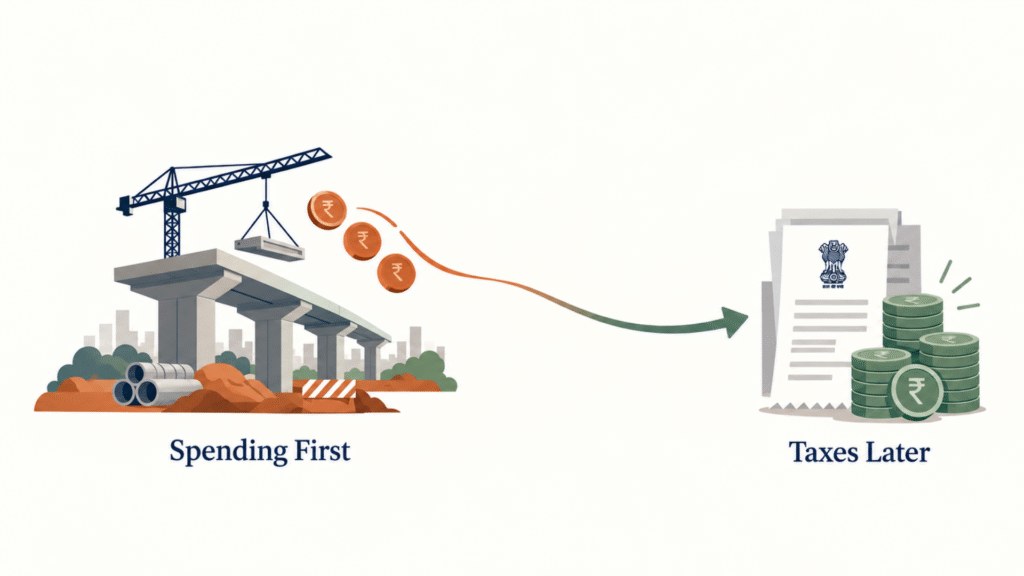
Capital spending, roads, railways, defence hardware, power infrastructure, tends to get pushed out early in the fiscal year, so construction and procurement have the full working season ahead of them. Tax revenue works in the opposite direction: advance tax payments land in June, September, December and March, and GST settlements cluster toward year-end. Expenditure leads, revenue lags. That mismatch alone guarantees the deficit-to-target ratio looks “ahead of schedule” for most of the year, every year.
Don’t take that on faith, look at where this exact number has landed in past Augusts:
| April–August | Fiscal Deficit as % of Full-Year Target |
| 2018 (FY19) | 94.7% |
| 2020 (pandemic year) | 109.3% |
| 2023 (FY24) | 36% |
| 2024 (FY25) | 27% |
| 2025 (FY26) | 38.1% |
| 2026 (FY27) | 41.9% |
The swing between 27% and over 100% in just a handful of years should tell you something: this particular number, measured in isolation, is close to meaningless. It only becomes informative once you place it against its own history. And by that yardstick, 41.9% isn’t an outlier. It’s the most ordinary number on the list.
What actually shifted this year
Compared to last year’s 38.1%, two things moved, modestly, and in offsetting directions. Expenditure ran slightly faster (38.9% of target vs. 37.1% last year), partly reflecting early capital spending on projects like the ₹20,804 crore railway multitracking push and the ₹1.86 lakh crore Green Energy Corridor. Revenue collection, meanwhile, was marginally ahead of last year’s pace too (29.2% vs. 28.6%). The deficit widened not because money stopped coming in, but because the government spent a little earlier and a little faster than it did twelve months ago.
The distinction the headline skips entirely
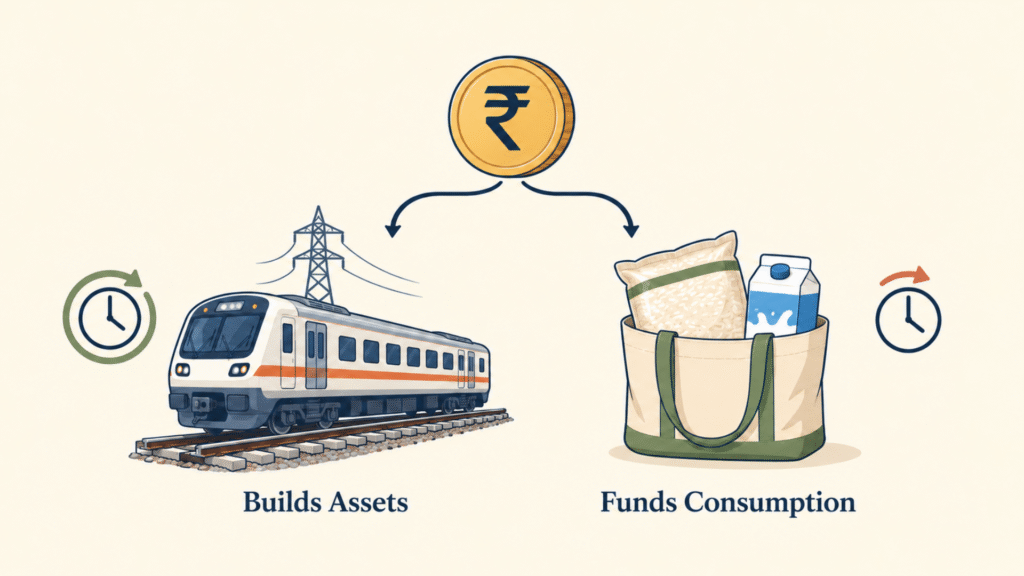
Not all borrowing is the same. A rupee borrowed to build a highway and a rupee borrowed to cover a subsidy bill show up identically in the fiscal deficit figure, even though one builds a long-lived asset and the other funds consumption that ends the moment the money is spent. That split, between capital and revenue expenditure, is the detail that actually separates a benign deficit from a worrying one. The August release doesn’t hand you that breakdown outright, so anyone drawing a hard conclusion from the 42% headline alone is filling in a gap with assumption, not data.
So what should you actually watch?
Not this number. The more useful checkpoint is where the ratio sits after December, once the bulk of advance tax and GST settlements have landed and the revenue side of the ledger has caught up. A deficit still running hot after the heavy-collection months would say something real. A deficit that cools off the way it has in most non-crisis years would confirm this was exactly what it looks like: a government spending early in a well-established seasonal pattern, not a fiscal position quietly coming apart.
Disclaimer: This blog is for educational and informational purposes only and does not constitute investment or financial advice. Data cited is from SEBI’s FY26 annual report, SEBI derivatives studies, AMFI, NSE and Government of India replies in Parliament. Please consult a SEBI-registered financial advisor before making investment decisions.
Contributor: Team Leveraged Growth


