
A Strategic Consolidation to Reshape India’s QSR Landscape
On January 1, 2026, two of India’s largest quick-service restaurant (QSR) franchise operators – Devyani International Ltd. and Sapphire Foods India Ltd., announced a landmark merger that promises to reshape the competitive dynamics of the Indian fast-food industry. Valued at approximately $934 million, the deal will combine the strengths of both entities to create a behemoth operating over 3,000 KFC and Pizza Hut outlets across India and select international markets.
From a strategic finance perspective, this transaction is more than a consolidation of restaurant counts; it’s a calculated effort to harness scale, improve profitability, and generate sustainable long-term value for shareholders in a historically margin-challenged industry.
Deal Structure and Shareholder Impact
The merger is structured as a share-swap transaction in which Devyani International will issue 177 of its equity shares for every 100 shares held by Sapphire Foods shareholders. Post-transaction, Sapphire Foods will cease to exist as a standalone corporate entity, with Devyani emerging as the listed parent company.
This share exchange has been designed to reflect relative equity valuations closely. Brokerages note that the swap ratio implies minimal arbitrage opportunity because it aligns with closing stock prices just before the announcement. For investors, this means the immediate re-rating potential from the transaction itself is limited; instead, value creation hinges on synergy realization and future operational improvements.
From a tax perspective, this is structured as a tax-neutral merger under Indian law. Shareholders typically will not incur capital gains tax at the time of a share exchange. Instead, taxes apply only when they eventually sell their Devyani shares, with the cost of acquisition adjusted on a proportionate basis.
Why Now? Industry Pressures and Strategic Rationale
Both franchisees have faced pressure in recent quarters. Rising operating costs, inflationary input prices, and softer discretionary consumer spending have squeezed margins across franchise operators, with both companies reporting losses in recent reporting periods. This merger comes against that backdrop of margin pressure, making scale and efficiency improvements not just beneficial but arguably essential.
From a strategic finance lens, the deal answers two critical questions:
- How do you compete with market leaders like Domino’s operator Jubilant FoodWorks?
The combined entity is expected to report revenue and operating profits 50-60% higher than the standalone companies, bringing it closer in scale to Jubilant. - Can the organizational structure become more efficient?
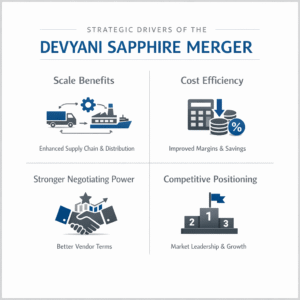
Analysts see benefits from a unified board and leadership, clearer commercial terms with Yum! Brands (the franchisor for KFC and Pizza Hut), and greater negotiating power with suppliers. These structural improvements reduce decision-making friction and improve capital allocation.
Expected Synergies and Financial Upside
One of the most critical value drivers cited by investment banks and brokers is synergy realization. The combined entity expects annual cost synergies of approximately ₹210-₹225 crore starting from the second full year of operations (around FY29). These synergies are expected to be reflected in:
- Lower royalty and marketing costs due to consolidated contracts with Yum! Brands.
- Reduced corporate overheads via the elimination of duplicated functions.
- Procurement and supply-chain efficiencies, delivered by purchasing at scale.
Brokerage models suggest that these operational synergies could translate into meaningful EBITDA expansion, adding an estimated 2.5% plus to EBITDA margins as scale benefits materialize.
Even before synergy realization, the sheer scale will command improved bargaining power with vendors and landlords, a material factor in a segment where rent and input costs dominate profit absorption.
Growth Strategy and Competitive Positioning
Beyond cost savings, the merger unlocks a broader strategic playbook:
- Acceleration of KFC expansion, especially in under-penetrated zones across tier-II and III cities.
- Revitalization of Pizza Hut, where consumer demand trends have lagged relative to fried chicken and snack formats.
- Geographic diversification, tapping deeper into international markets such as Sri Lanka and parts of Africa, which were more strongly represented in Sapphire’s footprint.
These initiatives aim not just at cost adjacencies but top-line growth, critical in improving long-term return on invested capital (ROIC).
Risks and Considerations
No merger of this size is without risks. Key areas that investors should monitor include:
- Integration Risk: Cultural and operational alignment across two complex organizations can take longer than planned. Realizing synergies requires disciplined execution and IT/ERP harmonization.
- Margin Pressure: Industry headwinds such as inflation in commodity prices (chicken, wheat, dairy) may continue to compress margins in the short term.
- Competition: Competitors like Jubilant FoodWorks (Domino’s) and Westlife Foodworld (McDonald’s India) continue to innovate with delivery-oriented offerings and aggressive pricing.
- Regulatory Timelines: The full integration is expected to take 12-15 months, subject to approvals from regulators and shareholders.
Conclusion: A Well-Timed Consolidation With Cautious Optimism
For long-term investors, the Devyani-Sapphire merger represents a strategic consolidation that addresses structural inefficiencies while enhancing competitive positioning in the Indian QSR market. The transaction’s success will be measured not by the announcement itself, but by how effectively the combined organization executes on synergy capture, brand revitalization, and disciplined expansion.
In financial terms, the merger has the potential to deliver improved operational leverage, higher scale, and enhanced margins, making it one of the most closely watched consumer sector transactions in India in recent years.
Contributor: Team Leveraged Growth


