
Why Intelligent People Also Make Dumb Investment Mistakes
Here is a fun fact that will hurt. 78% of Americans think they are better than average drivers. Statistically impossible, right? But we all do it. We overestimate ourselves. And nowhere is this tendency more expensive than in investing.
You would think smart people would be good at investing. Doctors, engineers, lawyers, CEOs, and people who have mastered complex subjects should crush the stock market.
They do not.
Research shows that actively trading investors consistently underperform the market. Professors Brad Barber and Terrance Odean analyzed over 66,000 household investors and found that the most active traders earned the lowest returns.
So what is going on? The answer is not about IQ. It is about psychology.
Welcome to the world of behavioral finance, where your brain is your own worst enemy.
The $1.2 Billion Question That Changed Everything
Warren Buffett and Charlie Munger got really rich by understanding a straightforward truth. Most people are predictably irrational.
At the 2015 Berkshire Hathaway shareholder meeting, Munger quipped,
“Warren, if people were not so often wrong, we would not be so rich.”
The world’s most successful investors did not get rich by being more intelligent than everyone else. They got rich by not being stupid when everyone else was.
Munger summed up his entire investing philosophy in one word. “Rationality.”
But even Buffett and Munger are not immune to mistakes. Buffett has publicly admitted several colossal failures.
Buying Dexter Shoe for $433 million, calling it his worst investment mistake.
Investing $2 billion in Energy Future Holdings without consulting Munger and losing $873 million.
Buying ConocoPhillips at the peak of oil prices for $7 billion and losing half its value.
Even the Oracle of Omaha makes emotional and irrational decisions. The difference is that he admits them, learns from them, and does not repeat them.
Why Traditional Finance Is Dead Wrong
For decades, economists believed in the Efficient Market Hypothesis, the idea that investors are rational, markets are efficient, and prices always reflect all available information.
But in the 1970s, two psychologists, Daniel Kahneman and Amos Tversky, looked at actual human behavior and said, “That is complete nonsense.”
They discovered that humans are not rational calculating machines. We are emotional, biased, and deeply flawed decision makers who make the same mistakes over and over again in predictable patterns.
Their work birthed behavioral finance, the study of why people make terrible financial decisions despite having all the correct information. In 2002, Kahneman won the Nobel Prize in Economics for this work. Here is their key insight, known as Prospect Theory.
Losses hurt about twice as much as gains feel good.
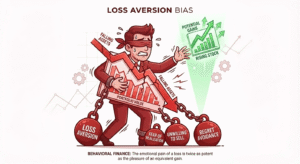
If you lose ₹10,000, it feels far worse than the pleasure of gaining ₹10,000. This explains why investors hold onto losing stocks for years, panic sell during market crashes, refuse to admit mistakes, and double down on bad bets.
Let us break down the biases that drain your portfolio and how to avoid them.
The 7 Deadly Biases That Kill Your Returns
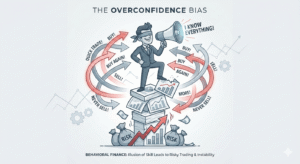
1. Overconfidence Bias: “I Know Better.”
64% of investors believe they have a high level of investment knowledge. Yet in 2023, only 25% of actively managed mutual funds beat the market over a 10 year period.
Overconfidence is the mother of all investing sins.
It shows up as trading too frequently, under diversifying by putting all your eggs in one basket, and ignoring risks because this time feels different.
Here is the brutal truth. The more you trade, the worse you do. Active traders consistently underperform passive investors who buy index funds and hold.
The fix is humility. As Munger said, “It is remarkable how much long-term advantage people like us have gotten by trying to be consistently not stupid, instead of trying to be very intelligent.”
Know what you do not know. Stick to your circle of competence.
2. Herd Mentality: “Everyone’s Buying It.”
Remember the dot-com bubble? Companies with zero revenue were going public, and everyone was buying in. Pets.com raised $82.5 million and went bankrupt in 268 days.
Studies show that just 5% of informed investors can influence the remaining 95%. That is terrifying.
FOMO, fear of missing out, drives herd mentality. When you see others making money on a hot stock, your brain screams that you need to get in before it is too late.
During COVID-19, millions flooded into meme stocks like GameStop and AMC. Many lost heavily when the hype died.
The fix is simple. Do your own research. Ask yourself, “Would I still buy this if no one else was talking about it?” As Buffett said, “Be fearful when others are greedy, and greedy when others are fearful.”
3. Loss Aversion: “I Will Sell When It Gets Back to What I Paid.”
This is the most expensive bias of all.
You buy a stock at ₹1,000. It drops to ₹700. Rationally, you should ask whether it is still a good investment at ₹700 based on fundamentals.
But instead, you wait for it to get back to ₹1,000.
Selling at ₹700 means admitting you were wrong. That feels terrible.
So you hold. Even as ₹700 becomes ₹500, then ₹300. Meanwhile, you sell your winning stocks too early out of fear of losing gains.
This is called the Disposition Effect, selling winners and holding losers. It is the opposite of the rule: cut your losses short and let your winners run.
The fix is discipline. Set predetermined exit rules before you buy. If the stock drops a certain percentage, you sell. No emotions.
Remember this. Your purchase price is irrelevant. The market does not care what you paid.
4. Anchoring Bias: “But It Was ₹5,000 Last Year.”
Your brain loves shortcuts. One of its favorites is anchoring to the first number it sees.
A stock traded at ₹5,000 last year. Today it trades at ₹2,000. It feels cheap.
But maybe it is not. The business may now be worth ₹1,000, and ₹2,000 could still be expensive.
Past prices are just numbers. They do not define value.
The fix is to ignore price history and focus on current fundamentals and future prospects.
5. Confirmation Bias: “See, I Told You So.”
Humans love being right. We actively seek information that confirms our beliefs and ignore information that contradicts them.
If you believe Tesla is the future, you will read praise and dismiss competition risks. If you think Bitcoin is a scam, you will read only negative views.
This creates an echo chamber where confidence increases while facts change.
The fix is discomfort. Seek opposing viewpoints. Read the bear case if you are bullish. Read the bull case if you are bearish. As Munger advised, use inversion and try to prove yourself wrong.
6. Recency Bias: “What Happened Yesterday Will Happen Tomorrow.”
Your brain gives too much importance to recent events.
In bull markets, optimism explodes. After crashes, fear dominates.
In 2023, several famous investors, including Michael Burry, Bill Ackman, and Ray Dalio, expected a crash. The S&P 500 surged around 25% instead.
Markets are forward-looking and unpredictable.
The fix is perspective. Zoom out. Focus on long-term trends. Markets move in cycles. As Buffett said, “The stock market is a device for transferring money from the impatient to the patient.”
7. Mental Accounting: “I Will Hold This Because Grandpa Gave It to Me.”
We attach emotional value to investments for no good reason.
Inherited stocks feel untouchable. Significant gains feel like house money.
This is mental accounting, treating money differently based on where it came from.
The fix is clarity. Money is money. A rupee is a rupee. Evaluate every investment purely on merit.
The Real Secret: It Is Not About Being Smart
Charlie Munger said, “Trying to be consistently not stupid beats trying to be very intelligent.”
The best investors acknowledge bias, build systems, slow down decisions, and focus only on what they can control.
The Bottom Line
Intelligence does not make you a good investor. Rationality does.
Rationality is not about being smarter. It is about being less dumb.
The greatest investors won by avoiding psychological traps, not by predicting the future.
So the next time you want to chase a hot stock, panic sell, or hold a loser until it gets back to your price, pause and ask yourself:
Am I being rational, or am I being human?
Because in investing, being human is expensive.
Contributor: Team Leveraged Growth


