
Picture two summaries of the same news, both sort of true.
“US shuts out foreign workers from Indian IT firms”, sounds like the door to America just slammed on TCS, Infosys, Wipro and HCL.
“US pauses one paperwork step for eight companies”, sounds like a footnote.
Neither is quite right. On October 8, 2026, the US Labor Department suspended eight companies from a programme called PERM. Here’s what was actually paused, why it happened, and how far the effect really reaches India.
What the PERM suspension actually announced
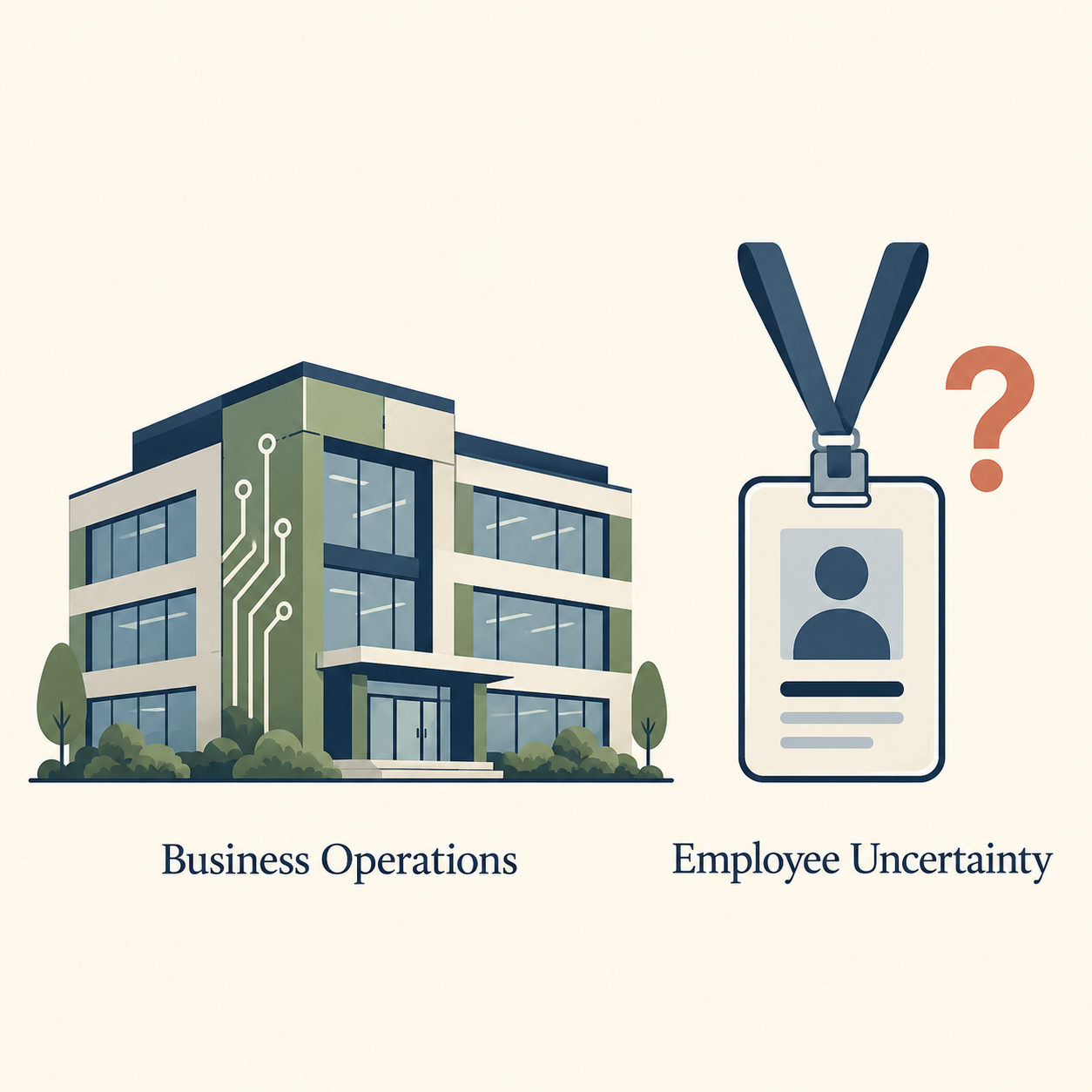
At a White House press conference on visa fraud, Vice President JD Vance stood alongside Labor Secretary Keith Sonderling as the department named the eight. Six are IT outsourcers: Tata Consultancy Services, Infosys, Wipro, HCL, Cognizant and Capgemini. The other two are American names, Microsoft and Adobe, suspended separately over active federal investigations.
The rule is simple: no new PERM applications from these companies, and no processing of the pending ones. Vance indicated the suspension could last as long as needed, even indefinitely.
The scale behind the decision, as stated by Sonderling: the eight together asked for nearly three million foreign workers since 2009, and received over 230,000 H-1B approvals and more than 100,000 permanent labor certifications.
H-1B vs PERM: the two visa programs everyone mixes up
Most of the confusion comes from treating two different systems as one.
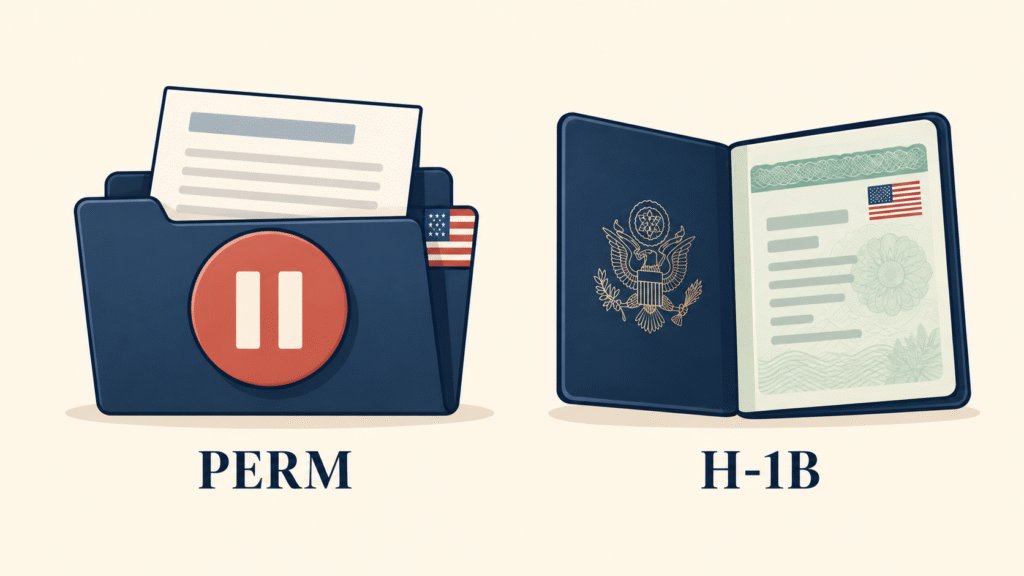
- H-1B is a temporary work visa for specialty jobs, generally valid for up to six years.
- PERM is the Labor Department’s labor certification, the usual first step when an employer sponsors someone for a green card. The employer has to show that no qualified American worker is available and that the hire will not hurt the pay or conditions of similar US workers.
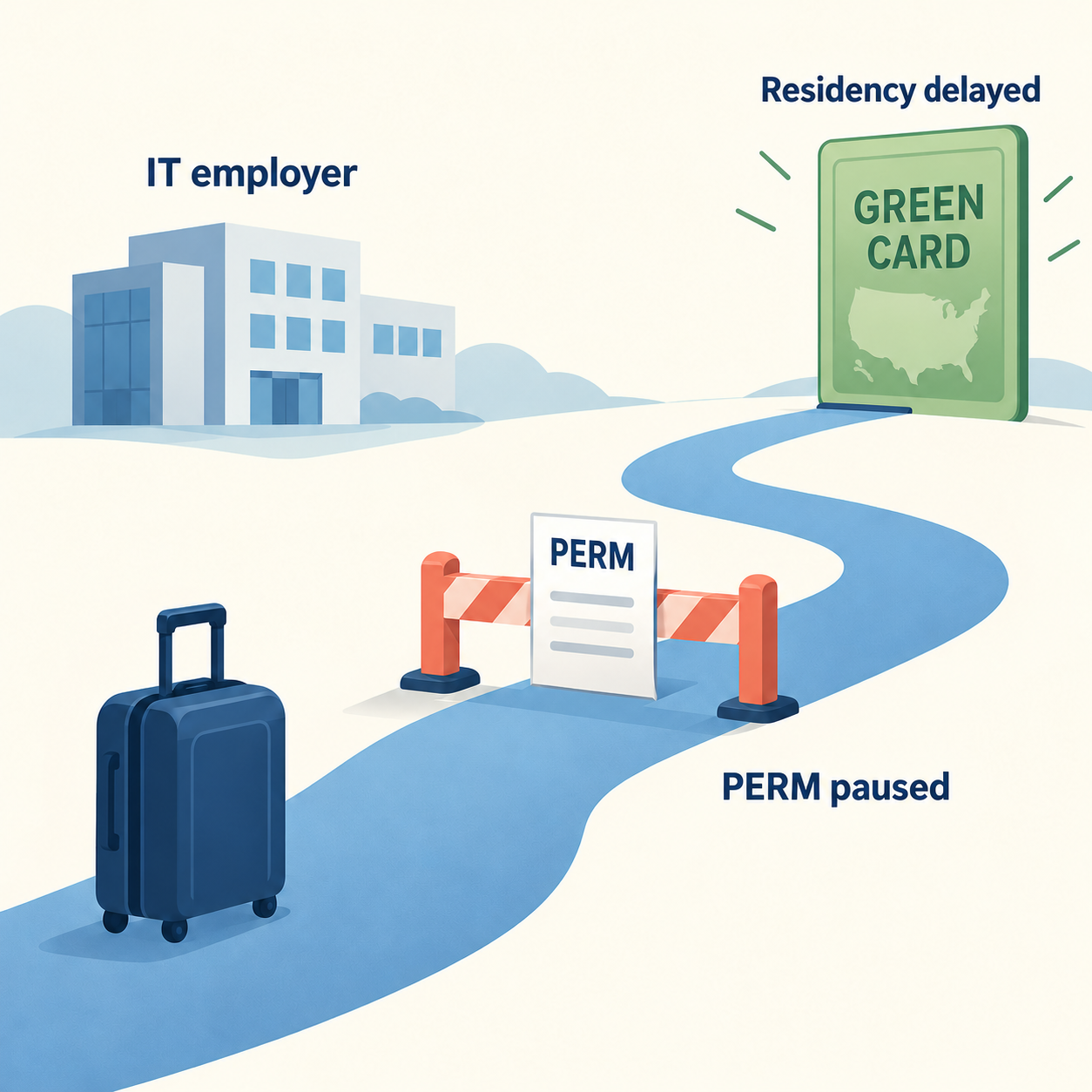
A PERM approval is not a green card. It is one door on the way to it. The suspension locks the second door for these employers; it does not touch the first.
India’s Ministry of External Affairs said exactly this: the suspension does not by itself affect existing H-1B visas or the status of holders and their dependents, though there could be an impact on the green card process of eligible employees at the affected companies.
Why the Labor Department suspended these companies now
The stated reason is alleged abuse. Officials argue that some employers use foreign workers to cut costs while laying off Americans. Vance singled out Microsoft, saying it laid off about 6,000 American workers in 2025 after certifying it could not find qualified American staff.
Microsoft pushed back. It said the vast majority of its US employees are Americans, and that about 80% of its H-1B applications last year were to extend or change the status of people already working for it.
Worth keeping in mind: these are allegations and investigations, not verdicts.
The announcement also did not arrive out of nowhere:
- In September 2025, US senators wrote to TCS asking how it could file H-1B petitions for thousands of foreign workers while laying off American staff.
- A one-time $100,000 fee on new H-1B petitions was attempted earlier, and was blocked by federal court orders.
- Cognizant had reportedly been suspended from PERM in September already.
- At the same event, a new visa-fraud strike team was announced, along with subpoenas to nine universities over alleged J-1 visa abuse. The crackdown is wider than IT.
What the PERM suspension means for Indian IT companies
The honest answer: less than the headline, more than zero.
Less, because the footprint is small. ICICI Securities noted that Indian IT firms made up under 2% of PERM applications filed between October 2024 and September 2025. TCS said its own PERM applications were in single digits over the last two years, and that it does not expect any change to its workforce strategy or client work. It also reaffirmed plans to hire another 15,000 people in the US over five years. Nasscom added that Indian companies have already reduced their reliance on H-1B and built up local hiring.
More than zero, because the cost lands on individuals. For an engineer waiting for a green card sponsored by one of these employers, the pause may mean more years on a temporary visa. ICICI Securities called the development negative for Indian IT stocks in the near to medium term, but through sentiment and talent retention rather than an immediate revenue hit. It also warned that prolonged uncertainty around residency could raise attrition among US-based workers. In other words, the risk is less about the balance sheet and more about people deciding whether to stay.
There was a diplomatic note too. The MEA called Vance’s “indentured servants” description of H-1B workers unwarranted, and said skilled-worker mobility benefits both economies.
The caveat that matters: none of the reports we reviewed say how many Indian professionals actually have pending PERM cases at these eight firms. Anyone quoting that number right now is guessing.
What to actually watch next
Not the headline. Four things are more telling:
- How long the suspension lasts, and whether it is formally extended.
- What the investigations find, and what the companies say in response.
- Whether other employers are brought into the same net.
- Whether more companies shift toward hiring locally, as TCS says it is doing.
A ripple that fades before it reaches the shore tells a very different story from one that keeps growing. Right now, the evidence points to the first. The next few months will say whether that holds.
Disclaimer: This blog is for educational and informational purposes only and does not constitute investment, immigration, or legal advice. Details cited are drawn from official statements by the US Department of Labor, India’s Ministry of External Affairs, company statements (TCS, Microsoft), and brokerage commentary (ICICI Securities, Nasscom). Please consult a qualified immigration attorney or SEBI-registered financial advisor for decisions specific to your situation.
Contributor: Team Leveraged Growth


