
You’re standing in the grocery aisle, reaching for your regular pack of cookies. Same price as last month. Same packaging. You toss it in your cart and move on.
Later at home, you open the pack. Something feels off. The cookies look smaller. Or maybe there are fewer of them? You check the package. Sure enough: 250 grams instead of the 300 it used to be.
That’s shrinkflation at work. And if you think that’s sneaky, wait until you hear about its even more insidious cousin: skimpflation.
What’s Actually Happening Here?
Shrinkflation is when companies keep the price the same but quietly reduce what you’re buying. That chocolate bar you loved? It went from 100 grams to 85 grams. Same wrapper design, same price tag, fewer grams. Your bag of chips has more air and fewer chips. Your toilet paper roll has fewer sheets.
Skimpflation is different, more insidious, actually. This is when the quality drops, but everything else stays the same. Your favorite restaurant starts using cheaper ingredients. That hotel you always book stops cleaning rooms daily. The product looks the same, costs the same, but delivers less value.
Think of it this way: shrinkflation is about quantity. Skimpflation is about quality. Both are ways for companies to deal with rising costs without raising prices. And both rely on you not noticing.
Why Now? Why So Much?
Let’s talk about Parle-G for a second. That orange packet has been a constant in Indian households for decades. It’s the biscuit that generations grew up dunking in chai. And it’s always been cheap, reassuringly, reliably cheap.
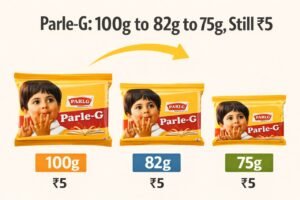
What most people don’t realize is that the ₹5 Parle-G packet has been on a diet. A serious one. It’s gone from 100 grams to 82 grams to 75 grams over the years. The price stayed at ₹5, but what you’re actually getting has shrunk by 25%. That’s a quarter less biscuit for the same money.
The numbers are wild when you actually calculate them. Britannia Industries reported that grammage reduction made up 65% of their price increase strategy in FY22. Every category has examples. Maggi noodles dropped from 100g to 70g in small packs. Britannia Good Day reduced from 100g to 75g. These aren’t small changes, they directly impact household budgets.
Your grocery bill looks the same, but you’re getting less food. Your actual cost per unit has jumped 15-20% without you realizing it.
The Psychology Behind It
Companies know something about human behavior: we hate price increases. We notice them. We complain. We switch brands.
But subtle changes in size or quality? Those slip past us. Your brain isn’t calibrated to notice that your shampoo bottle is 5% smaller or that your burger patty is slightly thinner. You might feel something is off, but you can’t quite put your finger on it.
This is deliberate. Package redesigns coincide with size reductions. New “improved formula” labels mask quality downgrades. Studies show that over 90% of consumers don’t check unit prices. In India’s fast-paced kirana shops and modern retail, people grab familiar brands without scrutinizing weights.
The whole system is built around this psychology. Companies maintain different pack sizes for different price points, constantly adjusting weights to protect those magical numbers. There’s always a ₹5 Parle-G available; it just keeps getting smaller.
The Skimpflation Experience
Quality degradation is harder to measure but easier to feel.
Your favorite local restaurant switches from paneer to a paneer-soya blend. That lassi isn’t full-fat yogurt anymore. Your gym cut trainers, so equipment help is scarce. Food delivery apps show restaurant portions getting smaller; that chicken biryani has noticeably less chicken than last year.
Service industries love skimpflation. Hotels are reducing housekeeping to every other day. Airlines like IndiGo are cutting amenities, no free water bottles and smaller snacks. Telecom companies are reducing the quality of customer support while keeping plan prices the same.
Sometimes they frame it as innovation. “Contactless service” instead of admitting they hired fewer people. “Streamlined experience” when they’ve actually just removed features.

What This Actually Costs You
Here’s where it gets personal.
Let’s say your typical grocery shop involves 30 products affected by shrinkflation, averaging a 10% reduction. Your cart still costs ₹5,000, but you’re actually getting ₹4,500 worth of goods at old quantities. That’s ₹500 less value per shop.
Do that twice a month. That’s ₹12,000 per year in hidden costs. For a family, it’s easily ₹20,000 to ₹25,000 annually. Not because prices went up on paper, but because you’re getting less for the same money.
Add skimpflation, slower internet, smaller restaurant portions, and longer customer service waits. These aren’t line items on a bill, but they’re real costs: wasted time, inferior experiences, stress. The frustrating part is that these hidden increases compound on top of the inflation you’re already paying for, making your rupee stretch less without any obvious explanation on your bills.
What You Can Actually Do
You’re not helpless. You just need to shop smarter.
- Master the unit price
Forget the giant “Family Size!” text designed to catch your eye. Look down at the shelf tag’s fine print, the unit price (cost per ounce, per 100g). This number doesn’t lie. It can’t be dressed up in new packaging or hidden behind marketing speak.
- Trust your instincts
If something you’ve bought for years suddenly feels wrong, different texture, cheaper construction, odd aftertaste, you’re probably right. Companies count on you dismissing this as imagination. Don’t.
Your brain is an excellent pattern-recognition machine. When it tells you something has changed, investigate.
- Consider the generic alternative
Store brands in 2026 have become surprisingly honest. Without massive marketing budgets to protect, they don’t need to play shrinkflation games to maintain margins.
The Bigger Picture
This isn’t just about cookies and chocolate bars.
Shrinkflation and skimpflation reflect something deeper about how modern capitalism operates. Companies face constant pressure to maintain profit margins. When costs go up, they find ways to protect margins without obviously raising prices.
The problem is transparency. If companies were upfront and said, “We’re raising our effective price by 10% through size reduction,” consumers could make informed choices. Instead, it’s hidden. Deceptive, even if technically legal.
There’s also a trust issue. These practices erode consumer confidence. Once you notice you’ve been subtly cheated, it changes how you view that brand. Trust is hard to rebuild.
And the inequality angle matters. Shrinkflation and skimpflation hit lower-income households harder. These families have less flexibility to switch stores, buy in bulk, or absorb higher per-unit costs.
The Reality Check
Shrinkflation and skimpflation aren’t going away anytime soon. Companies discovered that most consumers don’t notice, and those who do rarely change behavior enough to matter.
The Department of Consumer Affairs in India tracks MRP changes and has received complaints about shrinkflation. The Consumer Protection Act 2019 has provisions against unfair trade practices, though enforcement remains limited. Some consumer advocacy groups are pushing for mandatory “price per gram” labeling.
But enforcement is weak. Companies argue they’re not breaking laws because MRPs haven’t changed. The legal gray area is huge.
What might change is awareness. As more people understand what’s happening, as social media amplifies examples, companies may face more pressure to be transparent. Brands that play fair could gain loyalty. Brands that shrink too aggressively might lose customers.
The realistic view: this is part of how business works now. Consumers need to stay alert, check unit prices, and be willing to switch brands. It’s annoying. It takes effort. But so does losing 5% of your purchasing power without realizing it.
Next time you’re in a store, take a second look. Compare the sizes to what you remember. Check the weight on the package. Notice if that restaurant plate looks emptier than before. Small observations add up to big savings over time.
Because the companies are counting on you not noticing. Don’t give them that satisfaction.
Disclaimer
This article is for informational and educational purposes only and does not constitute investment advice. All valuation and correlation figures should be independently verified. Past market behaviour is not indicative of future results.
Contributor: Team Leveraged Growth


